News
Industrial Lithium Battery Recycling Machines
Time:2025-12-18 17:01:39
With the rapid development of the new energy industry, the large-scale decommissioning of power batteries, energy storage batteries, and consumer lithium-ion batteries has become a global problem. How to transform these spent lithium-ion batteries into reusable, high-value materials safely and environmentally is testing the technical capabilities of every recycling company. Industrial-grade lithium-ion battery recycling equipment has thus become an essential piece of infrastructure in the industry.
An industrial lithium-ion battery recycling machine is not simply a crushing device, but a complete system solution designed around "safe processing + efficient separation + high-purity recycling." Its objective is very clear: to disassemble a spent battery into standardized materials such as copper, aluminum, separators, and black powder, which can be directly used downstream, while minimizing risks.
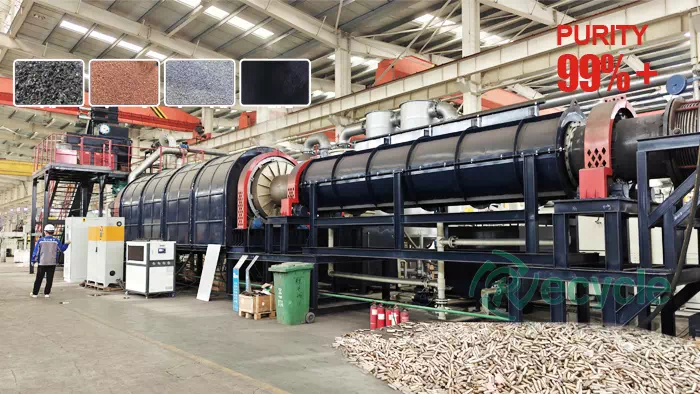
Industrial Lithium Battery Recycling Machines
From a process perspective, this type of equipment prioritizes safety from the outset. Different types of lithium-ion batteries undergo classification and thorough discharge before entering the main processing system, eliminating the risk of short circuits and explosions caused by residual electricity. Subsequently, the batteries enter a closed crushing system, where they are crushed in stages in a controlled environment, ensuring the complete release of internal structures, rather than simple "brutal crushing." This step directly determines the purity and stability of subsequent separation.
The crushed mixture then enters a drying and dehumidification stage, where electrolytes and moisture are effectively removed. This prevents material adhesion that could affect sorting and also creates conditions for environmentally friendly processing and long-term stable operation of the equipment. Next, the system uses a combination of multi-stage screening, airflow separation, and magnetic separation processes to separate materials of different densities and forms. Copper and aluminum are separated into high-purity particles, separator materials are collected separately, and the most critical black powder material is precisely extracted, providing high-quality raw materials for subsequent wet or pyrometallurgical processes.
In terms of recycling results, the value of industrial-grade lithium-ion battery recycling equipment is very clear. Under mature processes, the recovery rate of copper, aluminum, and other metals can consistently reach over 98%, and the black powder recovery rate also exceeds 98%, while the copper and aluminum impurity content in the black powder can be strictly controlled to below 1%. This means that recycling companies not only "recover the materials" but also "can sell them," directly determining the long-term profitability of the project.
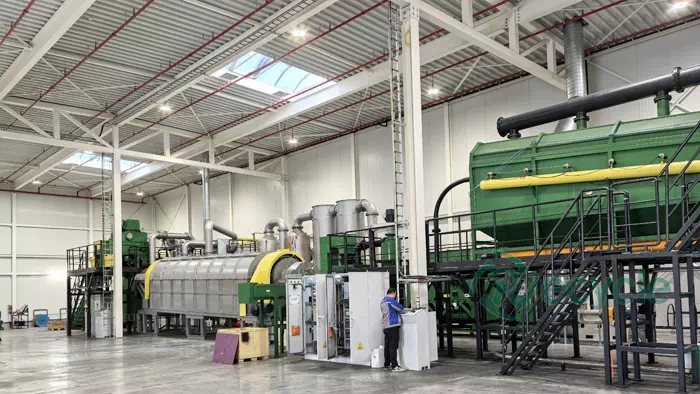
Lithium Battery Recycling Machines Site for a Belgian Customer
From an application perspective, this type of equipment is suitable for power batteries, energy storage batteries, 3C batteries, and various battery scraps. Depending on the processing scale, the entire production line can be configured to handle anywhere from several hundred kilograms to several tons per hour, meeting the flexible needs of small and medium-sized recycling companies while also supporting the continuous and stable operation of large-scale industrial recycling projects. Equipment power, structural layout, and automation level can all be customized according to site conditions and investment plans, which is a key difference between industrial-grade equipment and small-scale experimental equipment.
More importantly, industrial lithium-ion battery recycling equipment is not the "end point." In actual projects, it often serves as the core front-end of the entire recycling chain, providing a stable and standardized raw material base for subsequent black powder deep processing and metal extraction. Those who can achieve clean and stable separation at the front end will gain a cost and quality advantage downstream.
From the perspective of industry development, lithium-ion battery recycling has moved from the "whether it exists" stage to the "how well it's done" stage. The value of industrial-grade lithium-ion battery recycling machines is reflected not only in processing capacity and recycling rate, but also in safety control, continuous operation capabilities, and the ability to support future large-scale recycling. For companies that truly want to cultivate this industry long-term, choosing the right equipment is essentially laying the foundation for their competitiveness over the next decade.
LATEST NEWS
CONTACT US
Tel: 0086-13674945231(whatsapp)
Email: sunymachine@gmail.com
Add: Henan Communication Industrial Park) 5th St., Economic-Technological Development Zone, Zhengzhou